From The Washington Times and The Heritage Foundation:
FEULNER: Riding a tide of red ink
Even experts are clueless where the overspending will take us
By Ed Feulner
-
The Washington Times
4:44 p.m., Tuesday, August 3, 2010
Budget Director Peter Orszag (left), President Obama and Deputy Budget Director Ron Nabors face enormous budget deficits as the administration struggles with the recession, wars, health care and more. (Associated Press)PrintEmailView 0Comment(s)Enlarge Text
ShrinkClick-2-ListenSocial NetworksFacebookTwitterQuestion of the DayEngineers on Thursday pumped cement into the Gulf of Mexico's gushing oil well as part of an operation that could stop the leak for good. Will the leak be plugged by September?
Yes
No
Undecided
Other
Login to Vote
View results
It's no secret what the average American family does when income drops: It spends less and saves more. In fact, we've seen just that during these past two recessionary years. The personal saving rate, barely 1 percent of income in the first quarter of 2008, reached 5 percent last year and remains above 3 percent.
Businesses are doing the same thing. The Washington Post reported recently that nonfinancial companies are carrying about $1.8 trillion on their books, about 25 percent more than at the start of the recession.
This is partly because of federal meddling in the economy. With Obamacare heading their way, opaque financial regulations about to take force and lawmakers still contemplating a "cap-and-trade" law, companies figure some cash on hand can't hurt - if only to pay for new government-mandated rules. But they're also holding onto some cash because that's the logical thing to do when dealing with economic uncertainty.
So why this hasn't this wisdom trickled up to national leaders?
Our federal government is on a spending spree unheard of since World War II, when Washington poured resources into a two-front battle the country couldn't afford to lose.
The Obama administration's Mid-Session Budget Review predicts this year's budget deficit will top $1.4 trillion. That's 10 percent of the nation's economy. Measured in constant dollars, it's the largest deficit in American history. The president's team expects another $1.4 trillion deficit next year.
"These future deficits are driven almost exclusively by rising spending," notes budget expert Brian Riedl of the Heritage Foundation. "President Obama's budget would push inflation-adjusted federal spending past $36,000 per household by 2020 - $12,000 above the level that prevailed under President [George W.] Bush."
This year, the federal government is borrowing 41 cents out of every dollar it spends. Instead of saving up for future generations, we're spending money our offspring haven't earned yet and leaving them with nothing but bills and (in the Social Security trust fund) IOUs.
Even the experts admit they have no idea where this tide of red ink could carry our economy. "The United States may be able to issue more debt (relative to output) than the governments of other countries can, without triggering a crisis, because the United States has often been viewed as a 'safe haven' by investors around the world," notes a recent report from the nonpartisan Congressional Budget Office.
"On the other hand, the United States may not be able to issue as much debt as the governments of other countries can because the private saving rate has been lower in the United States than in most developed countries, and a significant share of U.S. debt has been sold to foreign investors."
To paraphrase: Nobody knows how long this can go on. Yet as an economist once said, anything that must come to an end, will. Eventually, foreign investors will realize the American government is carrying too much debt, and they'll stop lending it more money. Before that happens, our leaders need to get spending under control.
President Obama has appointed a commission to suggest ways to tame the nation's deficit. It's scheduled to report, conveniently, after the November midterm elections. Mr. Riedl writes that the commission should recommend that Congress:
c Reform Medicaid and bring long-term sustainability to Social Security and Medicare.
c Revisit the health care law to avoid creating an expensive new entitlement.
c Immediately reduce spending, not simplyset vague numerical targets that are seldom met.
Americans are behaving responsibly. We've tightened our belts and prepared for an uncertain future. Why can't government?
Ed Feulner is president of the Heritage Foundation.
© Copyright 2010 The Washington Times, LLC. Click here for reprint permission.
The Rise and Fall of Hope and Change



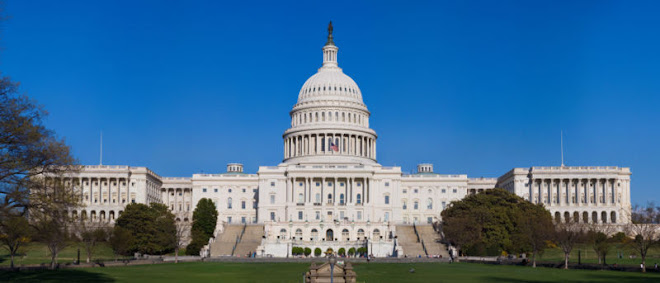
The United States Capitol Building
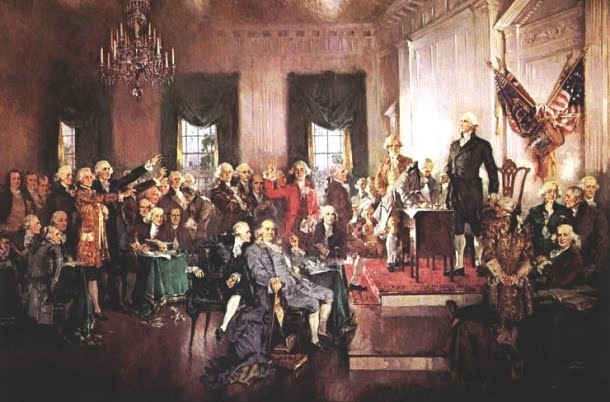
The Constitutional Convention
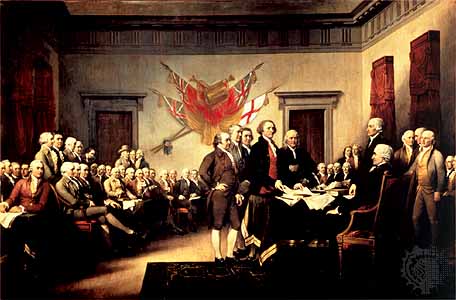
The Continental Congress
George Washington at Valley Forge





No comments:
Post a Comment