From The American Thinker:
August 06, 2010
The Death of the Dollar
By Vasko Kohlmayer
Nothing can save our financial system in the long run. It is doomed to collapse. This is inevitable, because our government controls and manages its very foundation -- the dollar.
The federal government began its takeover of the dollar in 1913 when it established the Federal Reserve Banking System. Prior to that the dollar was a real store of value. In the period from 1783 to 1913 there was a long period of currency stability with virtually no inflation. If you saved one dollar in 1800, your great grandchild could buy roughly the same amount of goods with the same dollar one century later.
In 1913 five dollars could get you the following:
15 pounds of potatoes, 10 pounds of flour, 5 pounds of sugar, 5 pounds of chuck roast, 3 pounds of round steak, 3 pounds of rice, 2 pounds each of cheese and bacon, and a pound each of butter and coffee... two loaves of bread, 4 quarts of milk and a dozen eggs.
In 2010 five dollars barely gets you two pounds of cut chicken meat.
Since the establishment of the Federal Reserve in 1913 the dollar has shed more than 90 percent of its value. The loss of value has been especially pronounced since 1971 when Richard Nixon took the dollar off the last vestiges of the gold standard. On that date the dollar became a pure fiat currency grounded in nothing but the whims of politicians and technocrats. The consequences have been disastrous. One thousand of 1971 dollars would only buy $185 worth of goods today. This represents a loss of some 80 percent in purchasing power.
The dollar has already entered its terminal phase. The word "doom" is written across it for anyone with the eyes to see. Sad to say, there is no way to reverse its downward slide. With more than $13 trillion in public debt and some $100 trillion in unfunded mandates our federal government has assumed far more obligations that it can ever make good on. Worse still, these figures are growing larger every year.
To put it bluntly, our federal government is flat-out bankrupt. Currency disintegration is always the unavoidable result of government bankruptcy. The dollar -- which has been weakening for many decades -- will at some point go into a sudden death spin.
The only question is when. It may happen six months from now or six years from now. The timeframe is impossible to predict, but we can now for certain that happen it will. No one -- not even the federal government -- can escape the numbers. And the numbers are hideous. One hundred trillion plus is a killer.
Under normal circumstances the dollar would have collapsed already given how impossibly indebted our government is. Some people are puzzled by its continued survival. They say this is just another sign that we live in a crazy world. But there is nothing crazy about it. The dollar is still alive, because there is no ready alternative.
Doomed though it may be in the long term, big time holders of US dollars keep desperately hanging on, because they have nowhere else to go. Where else could China invest its nearly one trillion dollar reserves? There is no easy option. So China keeps propping America's federal debt by purchasing Treasury notes and thus keeping the dollar afloat. It is a bad deal for China and a fortuitous one for the US, at least for the time being. But things cannot go on like this forever. Eventually something will give in and the whole gargantuan house of debt will come crashing down. When that happens things will get ugly.
Some people may say this situation has been brought about by reckless fiscal and budgetary policies rather than by the government's management of the currency. But the ability of government to run deficits is directly tied to its power to manage money.
It is very difficult for politicians to run large deficits if the currency is anchored in something intrinsically real and valuable, let's say gold. This is because when they post large budget shortfalls under a gold standard, people naturally ask them: "Where in the world are you going to get all the gold to pay for all this spending." And since politicians do not know how to make gold, they are forced to admit: "We are going to get it from you, the people, of course. Where else could it come from?"
As you can imagine, such answers do not usually go well with the voting public. The restrictive quality that real money exerts on the profligacy of politicians is often referred as "the golden handcuffs."
As it is now, most people do not think that they will have to pay for the spending incurred by their representatives in Congress. They think that deficits are something that does not concern them directly. They somehow assume the if the government needs more money it can simply issue more bonds. But this way of living is unsustainable and sooner or later the inflow from abroad will stop. Then we will all pay for our government's extravagance by the disintegration of the currency.
Traumatic as it may be, we should not be surprised by this. It has to end this way. This result became ineluctable the moment the American people gave government control over their money. Let's hope that we will learn from our mistakes. Let's hope that when the present monetary regime finally unwinds, we will have the wisdom to lay a more solid foundation for our money than the whims of politicians.
The Rise and Fall of Hope and Change


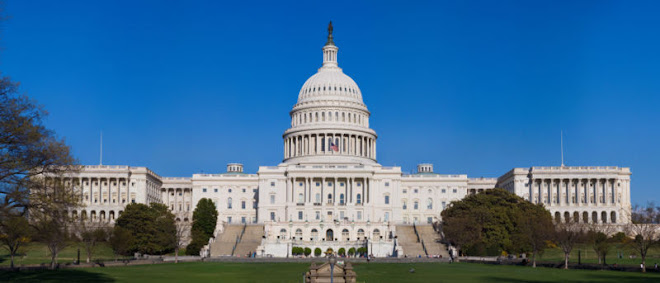
The United States Capitol Building
The Constitutional Convention
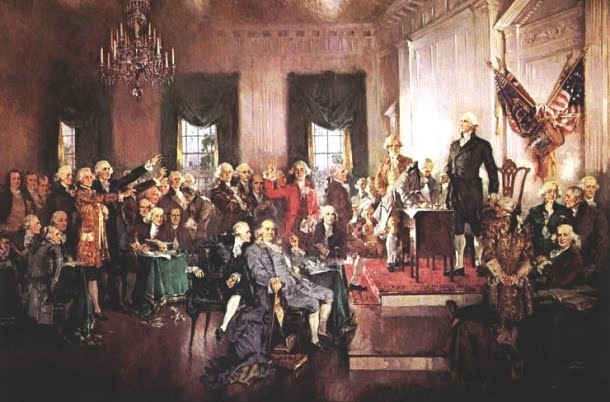
The Continental Congress
George Washington at Valley Forge



No comments:
Post a Comment