The following article is by Doug Bandow of the cato Institute:
Liberty and Virtue: Invaluable and Inseparable
Doug Bandow .There is no quicker means of raising a skeptical eye among some in politics than to endorse both liberty and virtue. Many people who consider freedom the preeminent political objective perceive support for virtue to be an implicit call for Taliban rule. Some advocates of virtue treat a vigorous defense of liberty like the promotion of vice.
This mutual hostility is evidenced by the growing strains between many social and economic conservatives. Yet neither liberty nor virtue is likely to survive alone.
Both freedom and virtue are under serious assault today. The role of government has been expanding exponentially, highlighted by passage of the federal takeover of the medical system. Virtue, too, seems to be losing ground daily. Evidence of moral decline is evident throughout American society.
At this critical time it would be a mistake to assume that one principle must be sacrificed for the other. Rather, freedom and morality are complementary. That is, liberty—the right to exercise choice, free from coercive state regulation—is a necessary precondition for virtue. And virtue is ultimately necessary for the survival of liberty. Anyone interested in building a good society should desire to live in a community that cherishes both values.
"Virtue cannot exist without freedom, without the right to make moral choices"
Virtue cannot exist without freedom, without the right to make moral choices. Coerced acts of conformity with some moral norm, however good, do not represent virtue; rather, the compliance with that moral norm must be voluntary.
There are times, of course, when coercion is absolutely necessary—most importantly, to enforce an inter-personal moral code governing the relations of one to another. Prohibiting crimes such as murder are obvious examples. In these cases law is necessary not to promote virtue, which depends on voluntary compliance based on internal conscience, but to protect others.
Very different, however, are attempts to mandate virtue, which reflects a standard of intra-personal morality. As such, it is an area that lies largely beyond the reach of state power. Which makes the role of non-governmental institutions, particularly the family and church, so much more important.
"The statist temptation nevertheless remains strong, and for obvious reasons. It takes a real commitment to principle to resist using government for one’s own end."
The statist temptation nevertheless remains strong, and for obvious reasons. It takes a real commitment to principle to resist using government for one’s own end.
Unfortunately, however, the state has proved that it is not a good teacher of virtue. Government tends to be effective at simple, blunt tasks, like killing and jailing people. It has been far less successful at the far more delicate task of reshaping individual characters. In fact, the sort of blunt social engineering that has characterized the liberal project for most of the 20th century has been far more likely to destroy individual liberty, conscience, and life.
Attempting to forcibly make people virtuous would make society itself less virtuous in three important ways. First, individuals would lose the opportunity to exercise virtue. In this dilemma we see the paradox of Christianity: a God of love creates man and provides a means for his redemption, but allows him to choose to do evil.
Second, to vest government with primary responsibility for promoting virtue shortchanges other institutions, like the family and church, sapping their vitality. Private social institutions find it easier to lean on the power of coercion than to lead by example, persuade, and solve problems. This phenomenon helps explain the expansion of the welfare state, as government has increasingly taken over the role of offering charity, providing health care, and meeting other human needs. Yet we are called to serve, to “suffer with,” as compassion once meant, not to turn our responsibilities to our neighbors over to the state.
Third, making government a moral enforcer encourages abuse by those who gain power. The effect of sin is magnified by the exercise of coercive power. As Lord Acton famously observed, "Power tends to corrupt, and absolute power corrupts absolutely." Its possessors can, of course, do good, but history demonstrates that they are far more likely to do harm, even if they start with the best of intentions. And centuries of experience demonstrate that many of those who wield political power have less positive ends in mind. They do so even in the U.S., despite the inevitable claim by politicians that they are speaking for the people.
"Moreover, as America's traditional Judeo-Christian consensus crumbles we are more likely to see government actively attacking traditional understandings of virtue"
Moreover, as America's traditional Judeo-Christian consensus crumbles we are more likely to see government actively attacking traditional understandings of virtue. Indeed, the state already increasingly promotes alternative moral views in public schools. The government seems increasingly likely to end up enshrining notions of virtue very different from those traditionally held by most people. All told, an unfree society is not likely to be a virtuous one.
The fact that government can do little to help does not mean that there is nothing it should do. Public officials should adopt as their maxim "first, do no harm." Simply protecting liberty by reducing state interference with private moral education would be one effective way to encourage the spread of virtue. Freeing students from failing government schools would be another step.
But freedom is not enough. While liberty is the highest political goal, it is not life's highest objective. For a Christian, for instance, the greatest commandments are to love God and one's neighbors. Helping people get in a right relationship with God is more important than reordering the political system.
Nevertheless, building a better society that protects justice and meets material needs is a worthy goal, and one most likely to be achieved through a free society. While a liberal, in the classical sense, economic and political system is the best one available, it will operate most effectively if nestled within a virtuous social environment.
A moral framework allows markets to operate far more smoothly. The virtues also reduce the perceived need for government. People who are honest, work hard, treat others with dignity, help the disadvantaged, and respect the rights of others require less outside regulation. A society made up of such individuals who do not victimize others and themselves invite fewer state restrictions on individual liberty.
Forming a moral social environment requires sustained effort. Although government is a poor means of molding character, collective action is required. In some cases the market process itself will encourage virtuous behavior—rewarding those who serve others, for instance. But for the most part moral education must come from outside the market.
Indeed, it should be understood that markets are merely one institution in a complex free society. Beyond commercial organizations are families, churches, seminaries, communities, clubs, and the manifold other forms of social interaction which so enrich our lives. It is the responsibility of all of us to create and support these institutions, which undergird our free society. Boycotts and shame are two powerful tools to strengthen social moral codes.
The left long has attempted to use state power to remake the individual and society. That experiment filled the 20thcentury with misery and death. This should come as no surprise. We will most flourish in societies which are both free and virtuous. Sacrifice either one, and the effort will almost certainly fail in its goal of making us into a better people.
Liberty and virtue are both under siege in today’s society. Neither value may survive without the other. We must defend both liberty and morality.
Doug Bandow is a Senior Fellow at the Cato Institute and the author of several books, including Beyond Good Intentions: A Biblical View of Politics (Crossway) and The Politics of Envy: Statism as Theology (Transaction).
The Rise and Fall of Hope and Change


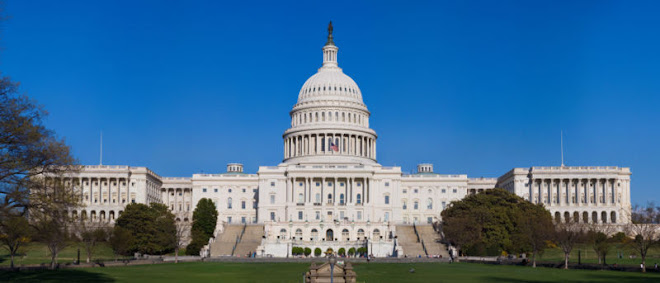
The United States Capitol Building
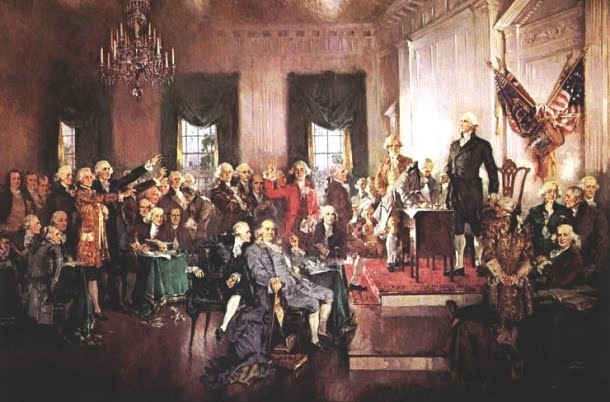
The Constitutional Convention
The Continental Congress
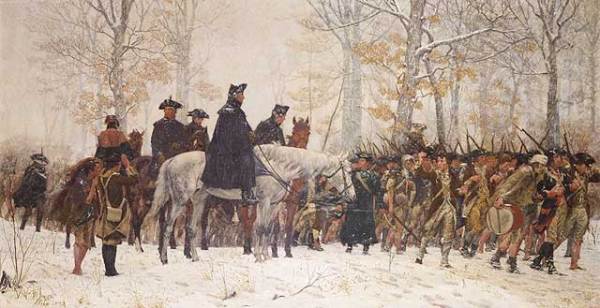
George Washington at Valley Forge


No comments:
Post a Comment