From The Heritage Foundation:
July 9, 2010
By Amanda J. Reinecker
Do You Make As Much as a Government Worker?
Federal employees are often called civil servants because their work is considered a "sacrifice" on their part to "serve" the public.
But for many of Uncle Sam's employees, it's not really that much of a sacrifice to work for the government.
Recent findings reveal that, on average, federal employees receive much higher pay, better compensation and more job security compared to their private sector counterparts, forcing a real sacrifice on the part of taxpayers to fund these elaborate benefits.
Heritage Foundation labor expert James Sherk has just released a study analyzing data from the Bureau of Labor Statistics' Current Population Survey for 2006 through 2009. He found that "the federal pay system gives the average federal employee hourly cash earnings 22 percent above the average private worker's, controlling for observable skills and characteristics." This translates to about $28.64 an hour for Uncle Sam's workers versus $18.27 an hour for those in the private sector.
But it's not simply better take-home pay. Federal workers also enjoy far better benefits. "The average private sector employer pays $9,882 per employee in annual benefits, while federal government pays an average of $32,115 per employee," writes Sherk. When factoring in these non-cash benefits, which include the coveted Federal Employees Health Benefit Program, federal employees are earning approximately 30 to 40 percent more in total compensation.
This all adds up. Sherk found that if federal employee compensation mirrored that of their private sector counterparts, federal spending would be reduced by $47 billion in 2011 alone.
That's right, that's $47 billion in savings if federal workers were paid like those in the private sector.
And this cost will only increase as the federal government adds more workers to its payroll. Unemployment currently stands at 9.5 percent and the economy continues to shed private sector jobs, but the government has added almost 200,000 jobs since the recession began. And these new hires, along with older ones, receive unmatched job security – a priceless commodity in today's market. Once hired, Sherk notes, feds "keep their jobs unless their supervisor works through an arduous process of exhaustively documenting their performance and working through a complex appeal process."
This imposes an enormous burden on taxpayers. As Heritage President Ed Feulner writes on Townhall.com, "federal over-compensation sends the wrong message, encouraging people to work for the government even though most federal jobs don't contribute much to overall economic growth."
Something has to be done. And Heritage Foundation experts have prepared common-sense solutions.
The federal government should:
1.Replace its seniority-based, wage-fixing pay scale with performance-based pay.
2.Reduce federal benefits.
3.Make it easier to dismiss unproductive employees.
Not all federal employees are overpaid. Some of the most skilled and hardest working are probably underpaid.
But the "government is a monopoly," writes Heritage's Conn Carroll. "It has no competitors to act as a check on employee compensation." Unless serious reforms are enacted, taxpayers are looking at an excess cost of $47 billion for civil "service" next year – whether it's good service or not. And that's a real sacrifice for taxpayers.
> Other Heritage Work of Note
•Writing in National Affairs, Heritage economist Rea Hederman digs past the hysterical headlines about the jobs report and explains what the various government measures of unemployment really mean.
•"The weaknesses of President Obama's New START treaty with Russia are finally starting to surface in Washington" reports Heritage Foundation Distinguished Fellow Jim Talent. As Talent reports, "the treaty reflects an agreement that the United States will not build a missile-defense system that could be used against Russia," and this will leave America potentially defenseless against a nuclear missile attack in the near future. Talent makes clear that there is no way the New START treaty can be enacted without significantly affecting America's defense, so the Senate should think twice about ratification.
•When new British Conservative defense secretary Liam Fox came to The Heritage Foundation last week, he raised the pending Defense Trade Cooperation Treaty between our two nations. Heritage Foundation Vice President Kim Holmes reports, "This treaty would make it easier for British defense companies to do business with American companies to improve the interoperability of our forces and develop the 'next generation' technologies our troops so urgently need." However, the treaty has yet to be ratified by the Senate, leading Fox to call for ratification but saying British patience is not unlimited. Since the United Kingdom is one of America's greatest allies in the war on terror, this treaty would allow our troops to get the help they need for victory.
• "Representation without Taxation" — that's the condition Heritage Foundation President Ed Feulner says exists for the bottom portion of income earners. Congressional Budget Office data indicates that "in 2007 (the most recent year for which figures are available) the top 20 percent of earners paid 70 percent of all federal taxes. The bottom 40 percent of earners paid no income tax." Feulner adds that "when people can vote themselves something for nothing, they will, and they'll keep squeezing the rich until they have nothing left to give." With the top 20 percent of earners paying 70 percent of federal income taxes, it's time to stop over-taxing the them before, as Feulner puts it, "we kill the goose that lays the golden eggs."
•President Obama and his liberal allies in Congress have made clear that they want to "spread the wealth around." The Heritage Foundation's J.D. Foster points out that "it seems Democrats are now threatening to spread some serious pain around as well." With the Bush tax cuts of 2001 and 2003 expiring at the end of this year, the Democratic leadership in Congress has said they are going to wait until after the election to prevent any tax hikes. "Obama and friends have long signaled that they intend to raise taxes on small businesses, seniors living off of investment income, and other rich folk" Foster notes. He also hopes that Americans will see through the left's "smokescreen" and speak up this election season.
> In Other News
•A federal district court judge struck down the 1996 Defense of Marriage law, a law that defines marriage for federal purposes as a union between a man and a woman, as unconstitutional.
» Read what Heritage expert Thomas Messner has to say about this ruling—and weigh in with your comments.
•CBS News reports that the Transportation Security Administration (TSA) is blocking access to five categories of websites deemed to be "inappropriate for government access." Among those firewalled are websites containing "controversial opinions."
•Even though the Deepwater oil well has not yet been plugged and even though the unemployment rate remains above nine percent, President Obama has unveiled a new campaign slogan: "Yes, we did."
•"The U.S. and Russia orchestrated the largest spy swap since the Cold War," the AP reports, "exchanging 10 spies arrested in the U.S. for four convicted in Russia in an elaborately choreographed diplomatic dance Friday at Vienna's airport."
•The Obama administration is planning to reinstate a ban on deepwater oil drilling, even though a court struck down its earlier ban and such bans will be economically costly to already reeling Gulf Coast states.
Amanda Reinecker is a writer for MyHeritage.org—a website for members and supporters of The Heritage Foundation. Nathaniel Ward, the Editor of MyHeritage.org, and Stephen Congdon, a Heritage intern, contributed to this report.
The Rise and Fall of Hope and Change


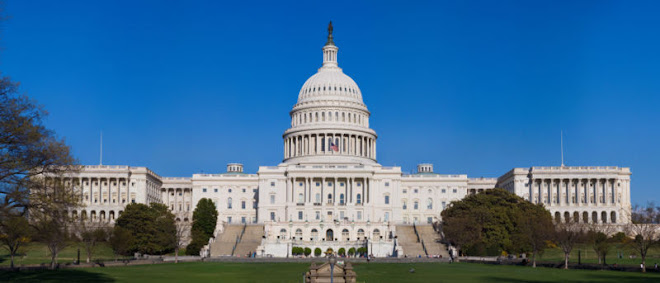
The United States Capitol Building
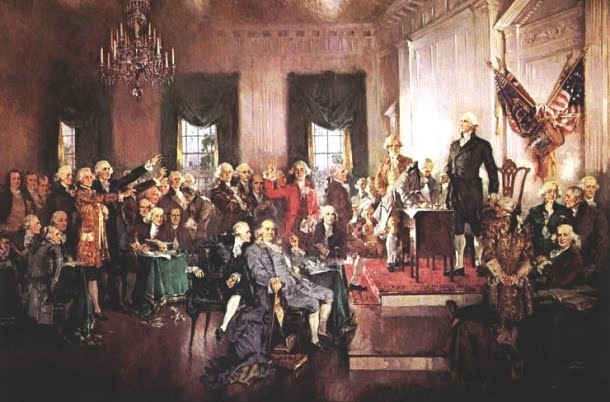
The Constitutional Convention
The Continental Congress
George Washington at Valley Forge




No comments:
Post a Comment