From The Patriot Update and White Horse Inn:
Burning Books or Proclaiming Christ
Sep.08, 2010 by Michael Horton in General
UPDATE – Go here to see Michael Horton’s update regarding this post.
To mark the anniversary of the 9/11 terrorist attacks, The Rev. Terry Jones is planning an “International Burn the Qur’an Day” at his 50-member Dove World Outreach Center in Gainesville, Florida. Yesterday Gen. David H. Petraeus warned that if a Florida church goes through with its plan to burn copies of the Qur’an this weekend, it could “endanger troops” and set back the U. S. war effort in Afghanistan. Beyond Afghanistan, it could spark protests and violence around the world (David Nakamura, Washington Post on-line, Sept 7, 2010). On Monday, 500 protesters at a Kabul mosque burned an effigy of Mr. Jones.
There is a long history of burning books when you don’t want to actually deal with the ideas that they promote. When the medieval church sponsored public bonfires of the Reformers’ writings, raw power seemed more convenient than reasoned argument. It’s an act of desperation. In other times and places, a call for Qur’an-burning would be dismissed as a crank’s irresponsible exercise of free speech, but in the present context, Jones has received more attention than perhaps even he could have imagined. To their credit, evangelical organizations—like the World Evangelical Fellowship and the National Association of Evangelicals—have been as vocal in opposing this incendiary event as liberal religious groups.
Especially given the timing of the event, NAE President Leith Anderson says that Terry Jones and his handful of supporters are engaging in “revenge” rather than the loving witness that Scripture teaches (citing 1 Thes 5:15). According to Mr Jones, however, “We only did it because we felt there needed to be an outcry against Islam, because Islam is presenting itself as a religion of peace” (The Christian Post on-line, July 30, 2010). Evidently, Mr. Jones believes that the best way of making the point that Islam is not a religion of peace is with a public burning of its primary text. I have not read his book released apparently for the occasion: Islam is of the Devil. Nor do I intend to do so (life is short). However, summaries point out that the author somehow sees American tolerance of Islam as the root of the nation’s social and moral evils. Another irony: on the Dove Center website, the seventh of Mr. Jones’ reasons for such book-burning is that “Islam is not compatible with democracy and human rights.”
In spite of the widespread Christian condemnation of the proposed action, this is not an isolated case. John Hagee leads a San Antonio, Texas, megachurch with a telecast that reaches 99 million homes around the world each week. His central message in books, sermons, and broadcasts is Christian Zionism—which includes a call for a pre-emptive strike of Iran by Israel. Although such voices are on the fringes of what used to be a more mainstream movement within evangelicalism, the basic paradigm (namely, radical dispensationalism) is held by millions of Christians in the U.S.. Besides the fact that Hal Lindsey’s Late Great Planet Earth was the best-seller of the 1970s and the Left Behind series by Tim LaHaye and Jerry Jenkins led the best-seller list for the 1990s, this popular end-times theology has played an influential role in foreign policy from Ronald Reagan to George W. Bush.
I do not doubt that many Christians who hold to these radical scenarios would denounce the incendiary proposals of Terry Jones and others. However, at a moment like this it is worth reminding ourselves what we believe and why we believe it. After all, as Christians our first question is not whether Qur’an-burning will set back war efforts in Afghanistan, but whether it is consistent with Christian neighbor-love and will set back efforts to reach Muslim neighbors with the Good News.
On one end are those who react by invoking religious pluralism. At least when it comes to Judaism, Christianity, and Islam, we are talking about the “Abrahamic faith traditions,” after all. We are all children of Abraham and should stop killing each other. As simple as this sounds, it is a position that no Christian can hold. The prophets—all the way to John the Baptist—announced that the true children of Abraham are all who trust in the coming Messiah. Jesus Christ made himself the focal point for the inheritance of everlasting life, replacing the Temple by forgiving sins directly in his person, proclaiming himself Lord of the Sabbath, welcoming the outcasts, and offering himself in death and resurrection for the life of all who embrace him. Paul, who had persecuted the church, was now the Apostle to the Gentiles and argued—just as Jesus had—that all who are united to Christ by faith are children of Abraham. The distinction between Jew and Gentile is abolished in the “new creation” that is Christ with his body. Faith, not law; justification in Christ, not physical descent or obedience to Torah, is the only way to become a child of Abraham—more than that, a child of God. By the way, this means that nominal Christians are no more children of Abraham than anyone else. There is only one way into the family: faith in Jesus Christ.
This means, of course, that all rival prophets, priests, and kings are pretenders. Judaism and Islam—as well as heretical forms of Christianity—reject the central claims of the gospel. Israel may be an ally of the U.S. whom we are obligated by moral and political ties to support as citizens. However, Israel is not holy land and no longer has any eschatological significance in the history of redemption. Where the Temple Mount once stood in redemptive history, Jesus now stands, calling, “Come to me all you who are weary and heavy-laden and I will give you rest.”
As citizens of democratic nations, Christians may be concerned about the implications of Qur’an-burning for international peace and justice. However, as citizens of the kingdom of Christ, they have even more reason to denounce such actions. Recall James and John—the “sons of thunder”—asking Jesus if they could call fire down from heaven on a Samaritan village that rejected their message. We read that Jesus rebuked them.
This is not the era of driving out the nations from God’s holy land, for the church is the only holy land and Christ is its living Temple. This is the era of enduring persecution, not for provoking or participating in it. In the Book of Revelation we read that it was not the martyr’s protests or book-burnings, but “the word of their testimony” and their witness to the Lamb that conquered the Beast.
Along with other religious distortions and denials of the Way, the Truth, and the Life, Islam belongs to that vast complex that makes up the Beast of the last days. Yet there are also “Christian” ways of looking away from Christ and attaching ourselves to the powers and principalities that array themselves against the Lord and his Messiah. Muslims need to encounter the power of faith in Christ that bears the fruit of hope and love. They need to hear the gospel and its central claims with gentleness and respect. Believers in Christ too are those who have been delivered from the power of sin and death and are not yet perfect in their understanding or actions. Christians are called to love Muslim neighbors simply because they are created in the image of God. Yet they are also called to proclaim the gospel and to explain and defend it, albeit with gentleness and respect.
As responsible citizens, we cannot help but be concerned about the political ramifications of Islam—especially since Islam is a geo-political as well as religious movement. Yet as citizens of Christ’s kingdom, we must resist the temptation to confuse U. S. interests with the goals of the City of God. Furthermore, we should recall the myriad ways in which Christianity confused these two kingdoms in its history—not only in medieval Christendom, but in the “God-and-Country” confusion that we see all around us today on the left and the right.
Muslims are our neighbors and regardless of what their religion encourages, our scriptures call us to imitate our Father who sends sunshine and rain on the just and the unjust alike. It is an era of common grace, a space in history for calling all people everywhere to repentance and faith in Christ. Our children play regularly with Muslim neighbors and sometimes the topic of religion comes up in conversation. It is interesting to overhear the interaction. On occasion, the oldest boy will ask me questions about Jesus and why we believe that he rose from the dead. I cannot imagine that the burning of the Qur’an this coming Saturday will help move that discussion along.
And also from White Horse Inn:
Michael Horton’s Follow-Up To ‘Burning Books or Proclaiming Christ’
Sep.09, 2010 by Michael Horton in General
I have to admit that many of the responses to my post have surprised me. Some of them sound eerily like the beliefs and attitudes of Muslim extremists. This may be in part because so many Christians in the United States still assume some of the errors of “Christendom.” On a cold November day in 1095, Pope Urban II roused a Christendom plagued by internal wars to take up the cause of holy war against Islam. “If you must have blood,” he exhorted, “bathe in the blood of infidels.”[1] Substituting itself for its ascended Lord, the church assimilated a civilization to that ecclesial body. “Our divinely favored emperor,” said the church father Eusebius concerning Constantine, “receiving, as it were, a transcript of the divine sovereignty, directs, in imitation of God himself, the administration of this world’s affairs.” With divine mandate, therefore, the emperor “subdues and chastens the open adversaries of the truth in accordance with the usages of war.”[2]
Although there were often lively debates as to whether the temporal and visible head of Christendom was the pope or the emperor, the medieval imagination was fed by this erroneous substitution of Europe for Israel of old. Monarchs fancied themselves King David redivivus, driving out the Canaanites with their holy knights. Islam actually learned a lot of its “jihadist” ways from Christendom. The glaring difference is that while the Qur’an and Hadith justify the use of violence in the struggle for worldwide submission, the Bible does not.
Unlike Islam, the biblical faith is an unfolding drama of redemption in which different covenants determine distinct policies and relationships between the kingdom of God and the kingdoms of this age. Under the old covenant pledged at Mount Sinai, Israel was a geo-political theocracy, commanded by God to drive out the idolatrous nations. It was a type of the Last Judgment at the end of the age. Yet Israel broke this covenant and was sent into exile; even when a remnant was allowed to return, the nation was under the oppressive reigns of successive empires. Then the Messiah arrived and in his Sermon on the Mount sharply re-defined the nature of his kingdom. Christ did not come to revive the old covenant (Sinai), but to fulfill it and to inaugurate the new covenant (Zion) with his own blood. No longer identified with a nation, his kingdom is the worldwide family that God promised to Abraham, Isaac, and Jacob. It is a “new covenant,” which is “not like the covenant” that Israel swore at Sinai (Jer 31:31-34). It is a kingdom of grace and forgiveness, an era in which the outcasts are gathered for the feast instead of driven out of the land. Even in the face of persecution, it is the hour for loving and praying for enemies, not for hating them or retaliating (Mat 5:43-48). Whereas God promised Israel temporal blessing for obedience and disaster for disobedience, today is the era of common grace. “For he makes his sun rise on the evil and on the good, and sends rain on the just and on the unjust” (v 45). One day, Jesus will return to judge the living and the dead and the holy wars that God commanded in the Old Testament will pale in comparison with the worldwide arraignment before the Son of God.
By the looks of many of these responses, though, America is “Israel.” America’s “war on terror” is not only a just war, defending national interests, but is in fact a holy war: “Onward, Christian Soldiers.” In this way, we become a mirror of Islam, reverting to bad “Christendom” habits that ignore the revolution that occurred in history when Jesus announced his “regime change” from the old to the new covenant, gave his life for his people, was raised for their justification, and sent his Spirit to make them witnesses to his Good News to the ends of the earth.
In this present era of history, Christ’s kingdom expands by the proclamation of the Word and the administration of the sacraments. Its heirs are also in the world as active citizens in the cultures and nations of this passing age, but their ultimate loyalty is to the Lord of lords. They can expect the world’s opposition. In fact, more Christians have been martyred in the last few decades than in all of the centuries combined. Yet the martyrs triumph through the word of their testimony—their witness to Christ, not through violence. This is the message of the Book of Revelation.
In my travels, I have met some of these brothers and sisters under constant threat of violence from Muslims in African, Asian, and Middle Eastern countries. I have had the privilege of getting to know others as seminary students and wonder at the daily struggles they face—and their joy in fulfilling their ministry regardless of the cost. They are willing to suffer for their testimony to Christ, but why should an American Christian put them in harm’s way for an act of violence that testifies to anger rather than redemption?
Just today I was sent an urgent appeal for prayer from Christian Solidarity Worldwide. In response to the Florida church’s plan to burn the Qur’an on Saturday, many Christian leaders in Nigeria and the Middle East have asked for our prayers. Here are a few requests passed on by CSW:
“Things are very, very difficult here…Several Village Heads who reported on Boko Haram have …been killed and then yesterday Boko Haram attacked Bauchi prison. The situation in Maiduguri is very tense. Please be praying for us. We need prayers for God’s grace and survival…We are the ones who are going to bear the brunt of [the burning of the Qur’an]. Since we saw news of what he plans we have been weeping and mourning. Ramadan will end here either end today or tomorrow. People are already moving their families away for safety.”
—From a pastor in Maiduguri, Nigeria, scene of the 2006 cartoon riots and the worst of the 2009 Boko Haram violence
“In northern Nigeria the tension is high. We are in great panic because if this occurs it will be worse than 2006, and most of our churches will be burnt down. If you can plead with those people to stop the burnings it will help us.”
—Anglican Bishop Musa Tula of Bauchi, Nigeria
“As I write the Iraqi Army Colonel has just left. He had a clear message: “There are plans to blow you up because of what the Pastor in Florida has said about burning the Holy Koran”. There is nothing we can do to protect ourselves. The army is being sent to us in force to try and protect us, what they can do is also limited…”
—The Reverend Canon Andrew White, Anglican Chaplain to Iraq
Provided by The Foundation for Relief and Reconciliation in the Middle East
Given especially the theological confusion underlying the anger expressed in some of the responses to my post, it is my hope and prayer that we can raise our thoughts higher than the daily news, to “the city that has foundations, whose designer and builder is God” (Heb 11:10). Whereas the blood of Abel cried out from the ground for vengeance, the blood of Christ pleads for forgiveness—and that is why we come not to Sinai, but to Zion “and to Jesus, the mediator of a new covenant, and to the sprinkled blood that speaks a better word than the blood of Abel” (Heb 12:22-24).
Burning the Qur’an is wrong for the following reasons: (1) It confuses the proclamation of Christ with violent conflict, justifying the suspicions of our secular and Muslim neighbors that Christianity is also a quasi-political movement; (2) It puts our neighbors around the world at risk, Christian and non-Christian, military and civilian; (3) It puts our brothers and sisters at greater risk, not for the gospel, but for an easy act of desperation that avoids the difficult sacrifice that fellow Christians around the world are making daily in their witness to God’s saving love in Christ.
[1] Robert Payne, The Dream and the Tomb: A History of the Crusades (New York: Stein & Day, 1985), 34
[2] Douglas Farrow, Ascension and Ecclesia, 115, from Orat. 1.6-2.5
The Rise and Fall of Hope and Change


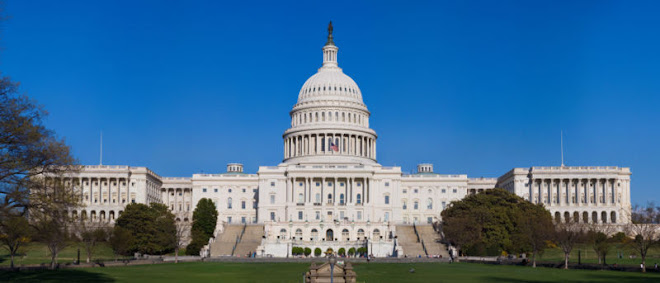
The United States Capitol Building
The Constitutional Convention
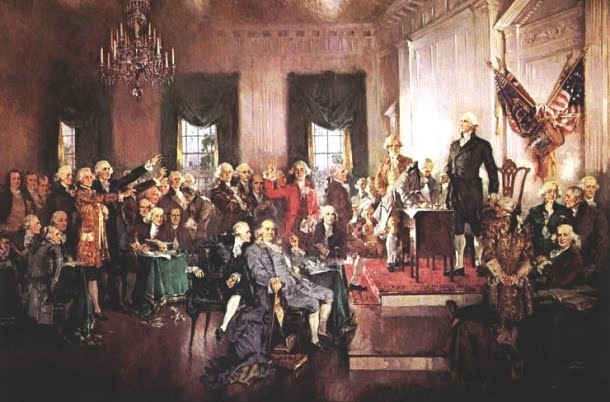
The Continental Congress
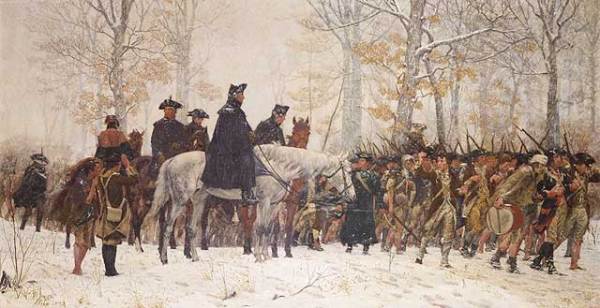
George Washington at Valley Forge



No comments:
Post a Comment