The Rise and Fall of Hope and Change

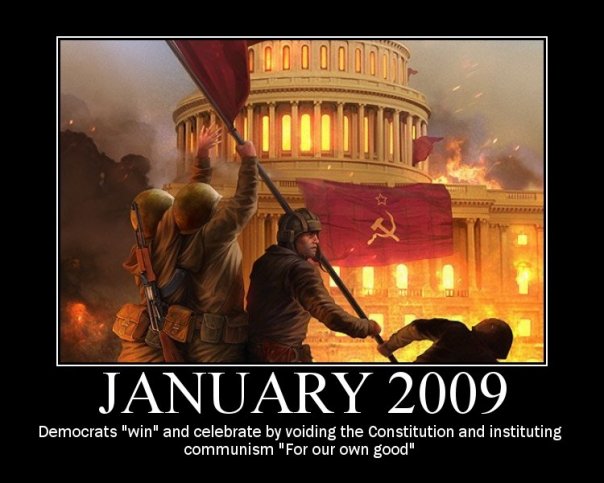
The Rise and Fall of Hope and Change


Alexis de Toqueville

The American Republic will endure until the day Congress discovers that it can bribe the public with the public's money.
Alexis de Tocqueville

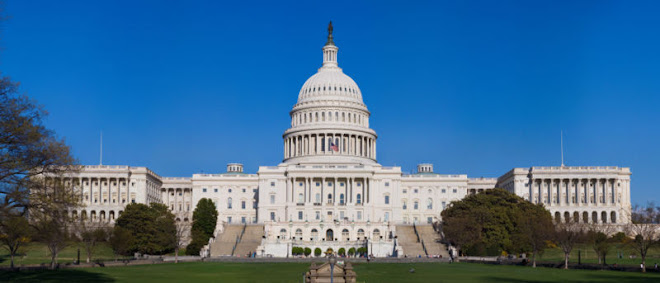
The United States Capitol Building

The United States Capitol Building

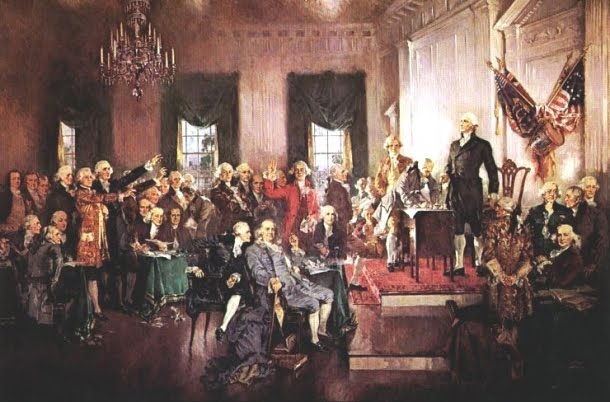
The Constitutional Convention

The Constitutional Convention

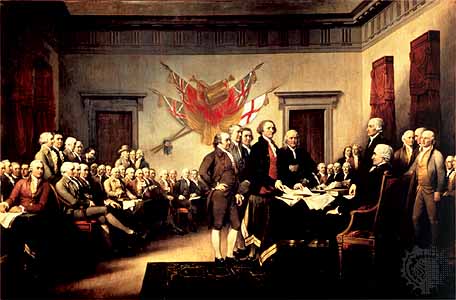
The Continental Congress

The Continental Congress

George Washington at Valley Forge

George Washington at Valley Forge


Sunday, January 30, 2011

Priorties...Priorities: Obama Spent One Hour On Egyptian Crisis, Then Two Hours Partying With Axelrod

From Gateway Pundit:

7:10 PM (27 minutes ago)Priorities… Priorities… Obama Spent 1 Hour Talking Egypt – Then 2 Hours Partying With Axelrodfrom Gateway Pundit by Jim HoftAs Egypt Burns…Obama Parties


It’s much worse than we thought.


Barack Obama sure is concerned about the future of the Middle East, Isreal and the world.


As Cairo burned yesterday he met with his security team — for an hour.


It was exhausting. He needed a break.


Then on Saturday night he went out and partied with Axelrod… for at least two hours!

Kristinn reported:


As thirty years of United States Middle East strategy teeters on collapse, Barack Obama spent Saturday night at a going away party for David Axelrod who is leaving the administration to set up Obama’s reelection campaign in Chicago. The party was held at the Dupont Circle condo of former Obama aide Linda Douglass.


Douglass, who is now with the National Journal, played host to a gathering of cabinet secretaries including Arne Duncan (Education), Timothy Geithner (Treasury) and Steven Chu (Energy) and prominent reporters including Major Garrett (National Journal), Jake Tapper (ABC), Chuck Todd (NBC) and John Harwood (CNBC/New York Times).


Obama spent nearly two hours at the party.


Everyone has their priorities.


Saturday, January 29, 2011

For New White House Press Secretary, Herding Media Back Into Obama's Lap Is Job #1

From Michelle Malkin:

4:32 PM (5 hours ago)For New WH Press Secretary, Herding Media Back Into Obama’s Lap is Job 1from Michelle Malkin by Doug Powers**Written by Doug Powers


Jay Carney, as you know, was **Time Magazine’s Washington bureau chief who is now charged with making President Obama look good in the press.


**The “Redundancy of the Day” is brought to you by Beltone hearing aids — to avoid having to repeat yourself, lend your loved one’s ear to Beltone!


Remember the re-set button Hillary gave to the Russians? Carney’s challenge is to give a similar one to the White House Press Corps. It seems that in the past couple of years, some in the media have strayed and actually started reporting what’s going on.


Time for a “come to Obama” meeting:


President Obama’s decision to tap Jay Carney as his new press secretary completes a series of White House personnel changes meant to mend dysfunctional relationships.


If new chief of staff Bill Daley was brought on to repair Obama’s relationship with business, then Carney’s appointment is designed to continue a charm offensive unleashed on the White House press corps shortly before the midterms.


The thinking inside the West Wing is that Carney, a longtime reporter and bureau chief for Time magazine who knows what it’s like to be a reporter, will smooth over relations with network executives and editorial page editors in addition to daily reporters at the White House.


Carney shouldn’t have much difficulty delivering the re-set button to anybody at ABC News. He’s married to Claire Shipman, ABC’s senior national correspondent on Good Morning America. Maybe another low-rated infomercial is in the works.


Carney’s “charm offensive” is expected to provide a stimulus to the Whitman’s Sampler company and save or create dozens of jobs delivering FTD Talk-Me-Up bouquets to media outlets all around the nation. Secretly distributing some of the same Hope & Change rufies that Chris Matthews slips himself on an almost nightly basis couldn’t hurt either.


**Written by Doug Powers


Twitter @ThePowersThatBe


Understanding Obama

From The Patriot Word:

5:31 PM (4 hours ago)Understanding Obama.... Drunk Philandering Luo Tribesman Reincarnatedfrom The Patriot Word by Walter L. Brown Jr.Understanding how Obama thinks is not easy. Dinesh D'Souza conclusion that he is playing the part of a drunk philandering Luo Tribesman reincarnated continues to be the best explanation of the current occupant of the White House's logic. We can't help but observe that the characteristics are eerily similar to Mohamed another tribesman that has caused a lot of trouble...


How Obama Thinks, Dinesh D'Souza,


Barack Obama is the most anti-business president in a generation, perhaps in American history. Thanks to him the era of big government is back. Obama runs up taxpayer debt not in the billions but in the trillions. He has expanded the federal government's control over home mortgages, investment banking, health care, autos and energy. The Weekly Standard summarizes Obama's approach as omnipotence at home, impotence abroad.


The President's actions are so bizarre that they mystify his critics and supporters alike. Consider this headline from the Aug. 18, 2009 issue of the Wall Street Journal: "Obama Underwrites Offshore Drilling." Did you read that correctly? You did. The Administration supports offshore drilling--but drilling off the shores of Brazil. With Obama's backing, the U.S. Export-Import Bank offered $2 billion in loans and guarantees to Brazil's state-owned oil company Petrobras to finance exploration in the Santos Basin near Rio de Janeiro--not so the oil ends up in the U.S. He is funding Brazilian exploration so that the oil can stay in Brazil.


More strange behavior: Obama's June 15, 2010 speech in response to the Gulf oil spill focused not on cleanup strategies but rather on the fact that Americans "consume more than 20% of the world's oil but have less than 2% of the world's resources." Obama railed on about "America's century-long addiction to fossil fuels." What does any of this have to do with the oil spill? Would the calamity have been less of a problem if America consumed a mere 10% of the world's resources?


The oddities go on and on. Obama's Administration has declared that even banks that want to repay their bailout money may be refused permission to do so. Only after the Obama team cleared a bank through the Fed's "stress test" was it eligible to give taxpayers their money back. Even then, declared Treasury Secretary Tim Geithner, the Administration might force banks to keep the money.


The President continues to push for stimulus even though hundreds of billions of dollars in such funds seem to have done little. The unemployment rate when Obama took office in January 2009 was 7.7%; now it is 9.5%. Yet he wants to spend even more and is determined to foist the entire bill on Americans making $250,000 a year or more. The rich, Obama insists, aren't paying their "fair share." This by itself seems odd given that the top 1% of Americans pay 40% of all federal income taxes; the next 9% of income earners pay another 30%. So the top 10% pays 70% of the taxes; the bottom 40% pays close to nothing. This does indeed seem unfair--to the rich.


Obama's foreign policy is no less strange. He supports a $100 million mosque scheduled to be built near the site where terrorists in the name of Islam brought down the World Trade Center. Obama's rationale, that "our commitment to religious freedom must be unshakable," seems utterly irrelevant to the issue of why the proposed Cordoba House should be constructed at Ground Zero.

Recently the London Times reported that the Obama Administration supported the conditional release of Abdel Baset al-Megrahi, the Lockerbie bomber convicted in connection with the deaths of 270 people, mostly Americans. This was an eye-opener because when Scotland released Megrahi from prison and sent him home to Libya in August 2009, the Obama Administration publicly and appropriately complained. The Times, however, obtained a letter the Obama Administration sent to Scotland a week before the event in which it said that releasing Megrahi on "compassionate grounds" was acceptable as long as he was kept in Scotland and would be "far preferable" to sending him back to Libya. Scottish officials interpreted this to mean that U.S. objections to Megrahi's release were "half-hearted." They released him to his home country, where he lives today as a free man.


One more anomaly: A few months ago nasa Chief Charles Bolden announced that from now on the primary mission of America's space agency would be to improve relations with the Muslim world. Come again? Bolden said he got the word directly from the President. "He wanted me to find a way to reach out to the Muslim world and engage much more with dominantly Muslim nations to help them feel good about their historic contribution to science and math and engineering." Bolden added that the International Space Station was a model for nasa's future, since it was not just a U.S. operation but included the Russians and the Chinese. Obama's redirection of the agency caused consternation among former astronauts like Neil Armstrong and John Glenn, and even among the President's supporters: Most people think of nasa's job as one of landing on the moon and Mars and exploring other faraway destinations. Sure, we are for Islamic self-esteem, but what on earth was Obama up to here?


Theories abound to explain the President's goals and actions. Critics in the business community--including some Obama voters who now have buyer's remorse--tend to focus on two main themes. The first is that Obama is clueless about business. The second is that Obama is a socialist--not an out-and-out Marxist, but something of a European-style socialist, with a penchant for leveling and government redistribution.


These theories aren't wrong so much as they are inadequate. Even if they could account for Obama's domestic policy, they cannot explain his foreign policy. The real problem with Obama is worse--much worse. But we have been blinded to his real agenda because, across the political spectrum, we all seek to fit him into some version of American history. In the process, we ignore Obama's own history. Here is a man who spent his formative years--the first 17 years of his life--off the American mainland, in Hawaii, Indonesia and Pakistan, with multiple subsequent journeys to Africa.


A good way to discern what motivates Obama is to ask a simple question: What is his dream? Is it the American dream? Is it Martin Luther King's dream? Or something else?


It is certainly not the American dream as conceived by the founders. They believed the nation was a "new order for the ages." A half-century later Alexis de Tocqueville wrote of America as creating "a distinct species of mankind." This is known as American exceptionalism. But when asked at a 2009 press conference whether he believed in this ideal, Obama said no. America, he suggested, is no more unique or exceptional than Britain or Greece or any other country.


Perhaps, then, Obama shares Martin Luther King's dream of a color-blind society. The President has benefited from that dream; he campaigned as a nonracial candidate, and many Americans voted for him because he represents the color-blind ideal. Even so, King's dream is not Obama's: The President never champions the idea of color-blindness or race-neutrality. This inaction is not merely tactical; the race issue simply isn't what drives Obama.


What then is Obama's dream? We don't have to speculate because the President tells us himself in his autobiography, Dreams from My Father. According to Obama, his dream is his father's dream. Notice that his title is not Dreams of My Father but rather Dreams from My Father. Obama isn't writing about his father's dreams; he is writing about the dreams he received from his father.


So who was Barack Obama Sr.? He was a Luo tribesman who grew up in Kenya and studied at Harvard. He was a polygamist who had, over the course of his lifetime, four wives and eight children. One of his sons, Mark Obama, has accused him of abuse and wife-beating. He was also a regular drunk driver who got into numerous accidents, killing a man in one and causing his own legs to be amputated due to injury in another. In 1982 he got drunk at a bar in Nairobi and drove into a tree, killing himself.


An odd choice, certainly, as an inspirational hero. But to his son, the elder Obama represented a great and noble cause, the cause of anticolonialism. Obama Sr. grew up during Africa's struggle to be free of European rule, and he was one of the early generation of Africans chosen to study in America and then to shape his country's future.


I know a great deal about anticolonialism, because I am a native of Mumbai, India. I am part of the first Indian generation to be born after my country's independence from the British. Anticolonialism was the rallying cry of Third World politics for much of the second half of the 20th century. To most Americans, however, anticolonialism is an unfamiliar idea, so let me explain it.


Anticolonialism is the doctrine that rich countries of the West got rich by invading, occupying and looting poor countries of Asia, Africa and South America. As one of Obama's acknowledged intellectual influences, Frantz Fanon, wrote in The Wretched of the Earth, "The well-being and progress of Europe have been built up with the sweat and the dead bodies of Negroes, Arabs, Indians and the yellow races."


Anticolonialists hold that even when countries secure political independence they remain economically dependent on their former captors. This dependence is called neocolonialism, a term defined by the African statesman Kwame Nkrumah (1909--72) in his book Neocolonialism: The Last Stage of Imperialism. Nkrumah, Ghana's first president, writes that poor countries may be nominally free, but they continue to be manipulated from abroad by powerful corporate and plutocratic elites. These forces of neocolonialism oppress not only Third World people but also citizens in their own countries. Obviously the solution is to resist and overthrow the oppressors. This was the anticolonial ideology of Barack Obama Sr. and many in his generation, including many of my own relatives in India.


Obama Sr. was an economist, and in 1965 he published an important article in the East Africa Journal called "Problems Facing Our Socialism." Obama Sr. wasn't a doctrinaire socialist; rather, he saw state appropriation of wealth as a necessary means to achieve the anticolonial objective of taking resources away from the foreign looters and restoring them to the people of Africa. For Obama Sr. this was an issue of national autonomy. "Is it the African who owns this country? If he does, then why should he not control the economic means of growth in this country?"


As he put it, "We need to eliminate power structures that have been built through excessive accumulation so that not only a few individuals shall control a vast magnitude of resources as is the case now." The senior Obama proposed that the state confiscate private land and raise taxes with no upper limit. In fact, he insisted that "theoretically there is nothing that can stop the government from taxing 100% of income so long as the people get benefits from the government commensurate with their income which is taxed."


Remarkably, President Obama, who knows his father's history very well, has never mentioned his father's article. Even more remarkably, there has been virtually no reporting on a document that seems directly relevant to what the junior Obama is doing in the White House.


While the senior Obama called for Africa to free itself from the neocolonial influence of Europe and specifically Britain, he knew when he came to America in 1959 that the global balance of power was shifting. Even then, he recognized what has become a new tenet of anticolonialist ideology: Today's neocolonial leader is not Europe but America. As the late Palestinian scholar Edward Said--who was one of Obama's teachers at Columbia University--wrote in Culture and Imperialism, "The United States has replaced the earlier great empires and is the dominant outside force."


From the anticolonial perspective, American imperialism is on a rampage. For a while, U.S. power was checked by the Soviet Union, but since the end of the Cold War, America has been the sole superpower. Moreover, 9/11 provided the occasion for America to invade and occupy two countries, Iraq and Afghanistan, and also to seek political and economic domination in the same way the French and the British empires once did. So in the anticolonial view, America is now the rogue elephant that subjugates and tramples the people of the world.


It may seem incredible to suggest that the anticolonial ideology of Barack Obama Sr. is espoused by his son, the President of the United States. That is what I am saying. From a very young age and through his formative years, Obama learned to see America as a force for global domination and destruction. He came to view America's military as an instrument of neocolonial occupation. He adopted his father's position that capitalism and free markets are code words for economic plunder. Obama grew to perceive the rich as an oppressive class, a kind of neocolonial power within America. In his worldview, profits are a measure of how effectively you have ripped off the rest of society, and America's power in the world is a measure of how selfishly it consumes the globe's resources and how ruthlessly it bullies and dominates the rest of the planet.


For Obama, the solutions are simple. He must work to wring the neocolonialism out of America and the West. And here is where our anticolonial understanding of Obama really takes off, because it provides a vital key to explaining not only his major policy actions but also the little details that no other theory can adequately account for.


Why support oil drilling off the coast of Brazil but not in America? Obama believes that the West uses a disproportionate share of the world's energy resources, so he wants neocolonial America to have less and the former colonized countries to have more. More broadly, his proposal for carbon taxes has little to do with whether the planet is getting warmer or colder; it is simply a way to penalize, and therefore reduce, America's carbon consumption. Both as a U.S. Senator and in his speech, as President, to the United Nations, Obama has proposed that the West massively subsidize energy production in the developing world.


Rejecting the socialist formula, Obama has shown no intention to nationalize the investment banks or the health sector. Rather, he seeks to decolonize these institutions, and this means bringing them under the government's leash. That's why Obama retains the right to refuse bailout paybacks--so that he can maintain his control. For Obama, health insurance companies on their own are oppressive racketeers, but once they submitted to federal oversight he was happy to do business with them. He even promised them expanded business as a result of his law forcing every American to buy health insurance.


If Obama shares his father's anticolonial crusade, that would explain why he wants people who are already paying close to 50% of their income in overall taxes to pay even more. The anticolonialist believes that since the rich have prospered at the expense of others, their wealth doesn't really belong to them; therefore whatever can be extracted from them is automatically just. Recall what Obama Sr. said in his 1965 paper: There is no tax rate too high, and even a 100% rate is justified under certain circumstances.


Obama supports the Ground Zero mosque because to him 9/11 is the event that unleashed the American bogey and pushed us into Iraq and Afghanistan. He views some of the Muslims who are fighting against America abroad as resisters of U.S. imperialism. Certainly that is the way the Lockerbie bomber Abdel Baset al-Megrahi portrayed himself at his trial. Obama's perception of him as an anticolonial resister would explain why he gave tacit approval for this murderer of hundreds of Americans to be released from captivity.


Finally, nasa. No explanation other than anticolonialism makes sense of Obama's curious mandate to convert a space agency into a Muslim and international outreach. We can see how well our theory works by recalling the moon landing of Apollo 11 in 1969. "One small step for man," Neil Armstrong said. "One giant leap for mankind."


But that's not how the rest of the world saw it. I was 8 years old at the time and living in my native India. I remember my grandfather telling me about the great race between America and Russia to put a man on the moon. Clearly America had won, and this was one giant leap not for mankind but for the U.S. If Obama shares this view, it's no wonder he wants to blunt nasa's space program, to divert it from a symbol of American greatness into a more modest public relations program.


Clearly the anticolonial ideology of Barack Obama Sr. goes a long way to explain the actions and policies of his son in the Oval Office. And we can be doubly sure about his father's influence because those who know Obama well testify to it. His "granny" Sarah Obama (not his real grandmother but one of his grandfather's other wives) told Newsweek, "I look at him and I see all the same things--he has taken everything from his father. The son is realizing everything the father wanted. The dreams of the father are still alive in the son."


In his own writings Obama stresses the centrality of his father not only to his beliefs and values but to his very identity. He calls his memoir "the record of a personal, interior journey--a boy's search for his father and through that search a workable meaning for his life as a black American." And again, "It was into my father's image, the black man, son of Africa, that I'd packed all the attributes I sought in myself." Even though his father was absent for virtually all his life, Obama writes, "My father's voice had nevertheless remained untainted, inspiring, rebuking, granting or withholding approval. You do not work hard enough, Barry. You must help in your people's struggle. Wake up, black man!"


The climax of Obama's narrative is when he goes to Kenya and weeps at his father's grave. It is riveting: "When my tears were finally spent," he writes, "I felt a calmness wash over me. I felt the circle finally close. I realized that who I was, what I cared about, was no longer just a matter of intellect or obligation, no longer a construct of words. I saw that my life in America--the black life, the white life, the sense of abandonment I'd felt as a boy, the frustration and hope I'd witnessed in Chicago--all of it was connected with this small piece of earth an ocean away, connected by more than the accident of a name or the color of my skin. The pain that I felt was my father's pain."


In an eerie conclusion, Obama writes that "I sat at my father's grave and spoke to him through Africa's red soil." In a sense, through the earth itself, he communes with his father and receives his father's spirit. Obama takes on his father's struggle, not by recovering his body but by embracing his cause. He decides that where Obama Sr. failed, he will succeed. Obama Sr.'s hatred of the colonial system becomes Obama Jr.'s hatred; his botched attempt to set the world right defines his son's objective. Through a kind of sacramental rite at the family tomb, the father's struggle becomes the son's birthright.


Colonialism today is a dead issue. No one cares about it except the man in the White House. He is the last anticolonial. Emerging market economies such as China, India, Chile and Indonesia have solved the problem of backwardness; they are exploiting their labor advantage and growing much faster than the U.S. If America is going to remain on top, we have to compete in an increasingly tough environment.

But instead of readying us for the challenge, our President is trapped in his father's time machine. Incredibly, the U.S. is being ruled according to the dreams of a Luo tribesman of the 1950s. This philandering, inebriated African socialist, who raged against the world for denying him the realization of his anticolonial ambitions, is now setting the nation's agenda through the reincarnation of his dreams in his son. The son makes it happen, but he candidly admits he is only living out his father's dream. The invisible father provides the inspiration, and the son dutifully gets the job done. America today is governed by a ghost.

Dinesh D'Souza, the president of the King's College in New York City, is the author of the forthcoming book The Roots of Obama's Rage (Regnery Publishing).

Correction: Dinesh D'Souza writes that on June 15, 2010, Obama gave a speech in response to the BP oil spill that was "focused not on cleanup strategies but rather on the fact that Americans 'consume more than 20% of the world’s oil but have less than 2% of the world’s resources.'" D'Souza slightly misquoted the President who said, "2% of the world's oil reserves." In addition, Obama's speech did discuss concrete measures to investigate the oil spill and bring it under control.

Friday, January 28, 2011

Obama, In A Bubble Of His Own Making

From The American Thinker:

January 26, 2011


Obama in a bubble of his own making

Rick Moran

The temptation when you work in the White House as president is to close yourself in, shutting out the world beyond the gates, with the hubristic belief in your own perfection. After all, you made it all the way to the White House - what does the rest of the world know that can help you?


Good presidents always have one or two aides that will disabuse him of his own brilliance. They try to cut through the staff sycophants and yes men in order to present the real world to the president - warts and all. But apparently, Obama's arrogance extends to his inner circle as well.


John Hielermann:


Few perceptions were more widely shared or loudly voiced around Washington than that the Obamans were huffing their own fumes. "You know the cliché about our strengths being our weaknesses? It's true for them as well," says a top political strategist in a previous White House. "I think they felt like if they had listened to conventional wisdom in 2007, they never would have run. When they hear criticism, they say, ‘Been there, done that, we're gonna stay the course.' There's almost a Zen-like quality about how they've been in their own universe and their own bubble."

The more pointed variant of this critique was directed specifically at Obama. Unlike 42-who loved to stay up late, jabbing at the speed dial, spending countless hours gabbing with local pols and businesspeople around the country to gauge the political wind and weather-44 not only eschewed reaching out to governors, mayors, or CEOs, but he rarely consulted outside the tiny charmed circle surrounding him in the White House. "What you had was really three or four people running the entire government," says the former White House strategist. "I thought they put a pretty good Cabinet together, but most of those guys might as well be in the witness-protection program."


A funny line, no doubt, but an overstatement, surely? Well, maybe not. "I happen to know most of the Cabinet pretty well, and I get together with them individually for lunch," says one of the most respected Democratic bigwigs in Washington. "I've had half a dozen Cabinet members say that in the first two years, they never had one call-not one call-from the president."


(H/T: Hot Air )


Cabinet members have been reduced to glorified PR people for their departments over the years so I am not concerned that the president hasn't talked with the Secretary of Commerce or the Secretary of Veterans Affairs. They don't run those departments anyway - their assistant secretaries do the job.


What is much more troubling is the president's failure to reach out and discover what the rest of the country really thinks of his policies. That kind of myopia leads to bad government - which is what we have now. And Obama shows no signs of changing.


The State of the Union speech tonight will probably sound strange to most of us because of this disconnect.


Posted at 12:05 AM

On-going Disaster In The Gulf

From The American Thinker:

January 26, 2011


Ongoing Disaster in the Gulf

By George Scaggs

While the BP Deepwater Horizon oil spill and the Obama administration's subsequent six-month moratorium on deep-water drilling in the Gulf of Mexico are common knowledge, the fact that the federal government has turned the tragic accident into an ongoing economic calamity seems to be drawing scant attention.


Though the drilling moratorium was officially lifted three months ago, it has been replaced with an ongoing de facto ban. But the full scope and damaging consequences of the federal government's reactions to the gulf spill go well beyond deep-water drilling.


While the moratorium was limited to deep-water rigs, the work stoppage in the Gulf was not. Due to new regulations and ever-evolving permit processes, many shallow-water oil and gas drilling operations have been effectively shut down as well. Mind you, there is no evidence that the rigs being prevented from operating are anything but safe.


During the six-month hiatus, though most companies decided to ride out the situation (believing the work stoppage was for a fixed period of time), no fewer than five of the 33 deep-water rigs in operation at the time of the spill moved to foreign shores to fulfill their intended purpose.


Now rig owners, the contractors who lease them, and tens of thousands of workers find themselves subject to an indefinite waiting game as the federal bureaucracy mills about. As rigs continue to sit idle, pressure is mounting for contractors to void existing leases, and an increasing number of jobs are under threat.


Indeed, just this month, Marathon Oil terminated its contract on the Noble Corp's Jim Day rig that arrived in the Gulf in September. Similarly, deep-water rigs built by Pride International and the Maersk Group which were intended to set up operations in the Gulf have been redirected elsewhere.


Less oil drilling in the Gulf means less oil production in the Gulf. In addition to drilling rigs sitting dormant, many of the hundreds of production platforms operating in the Gulf have also been affected. From there, the ripple of economic death extends out to equipment, transportation, fuel and food suppliers, and other businesses that support the region's oil industry and its workers.


The frustrations of Gulf Coast residents affected by the federal government's actions were on full display earlier this month (seen here and here) as Oil Spill Czar Feinberg held a series of town hall meetings in Mississippi and Louisiana coastal communities. Many local businesses harmed by the oil spill are still suffering due to the government shutdown of the oil and gas industry in the Gulf.


With no recovery in sight for our nation's private-sector job market and government revenues (at all levels) consequently stagnating, if not declining, it is troubling to find the federal government in the business of killing private-sector jobs, and many of them good middle-class jobs, in wholesale fashion.


Though it has been estimated that some 20,000 jobs have been lost due to the federal government's actions, Lee Hunt, President of the International Association of Drilling Contractors (IADC), contends that job losses are only a part of the overall economic impact resulting from the continued ban.


The massive deepwater rigs that operate in the Gulf generate about $500,000 per day in revenues, though numerous owners have reduced daily rates by as much as $200,000 to keep companies in place while the shutdown continues. Additionally, Hunt estimates that "companies spend approximately another half million a day for consumables, transportation, maintenance operations and other costs" per rig.


All told, Hunt conservatively estimates that there is a direct "$30 million a day negative impact to the economy" due to the deep-water shutdown alone. However, he said that considering factors including lower dividend payments, stock prices, lost wages and investment dollars, "the total enterprise loss is incalculable."


Texas Railroad Commissioner Elizabeth Ames Jones, who is one among three commissioners overseeing Texas energy policy, agrees, commenting that "[p]eople should be up in arms[;] it's not as though we [America] can afford this much longer."


So where are the Democratic Party and Big Media on this development? The self-proclaimed champions of the "little guy" have fallen strangely silent, considering the dramatic impact on jobs and prosperity in the Gulf Coast region.


When thousands of jobs are lost due to corporate layoffs, it is the stuff of headlines. When the jobs of local and state bureaucrats are threatened unless they receive federal "stimulus" funding, a hue and cry goes out across the land. But when the government kills private-sector jobs, the sufferings of average Americans are suddenly of no import whatsoever.


Indeed, though local news outlets thoroughly covered Feinberg's recent visit to the region, one would be hard-pressed to find any national coverage of the controversial meetings which took place. This is a direct contrast to media coverage when the ire of Gulf Coast residents was directed at BP.


Official sources now project a 13% decrease is domestic oil production in 2011, and most industry executives now predict that it will take several years before production in the Gulf of Mexico returns to 2009 levels. Hunt predicts that by the end of 2011, only four to ten deep-water rigs in the gulf will have returned to full operation. These are troubling developments, considering America's already overwhelming dependence on foreign oil.


The shutdown in the gulf will also have a direct impact on the size of the federal government's deficit. Though leftist politicos inside the Beltway routinely demonize the oil industry, in truth, Washington reaps huge windfalls from the industry in the form of royalties and excise taxes.


In sum, there are two rather troubling realities which are completely at odds with the present course being pursued by an overzealous federal government and the intrusive "Green" movement that sets the tone for much of today's government policy.


First, energy produced from oil and gas is literally the fuel for the world's major economies. As unpalatable as it must be for some, economic prosperity throughout the world depends on oil and gas.


Secondly, much of government's revenues come from the exploration, production, and usage of these hydrocarbons.


Whether the continuing disaster in the Gulf of Mexico is due to deliberate government fiat or just gross bureaucratic incompetence, the results are the same. Congress should act immediately to end the Obama administration's overreach into this vital American industry.

Obama The Alchemist Would Pluck Your Savings Clean

From The American Thinker:

January 26, 2011


Obama the Alchemist Would Pluck Your Savings Clean

By Geoffrey P. Hunt

Whatever abject failings Obama has as a statesman or legislative leader, he's become a master wizard at projecting illusions and capturing the yearning of so many who want to be deceived. There have always been people like Obama, and the greats of literature have satirized them.


Subtle, the con-man alchemist; Face, an unscrupulous butler; and Dol, a common London street prostitute, open Ben Jonson's popular and enduring 1610 farce by arguing how to swindle the gullible ones. Such a caricature couldn't possibly resemble the leading political actors a year ago, could it?


The Alchemist, a drama combining medieval sleight-of-hand and magic, captured the bawdy imagination of post-Elizabethan theatergoers. It was two hours of lewd repartee and characters unconvincingly taking on new appearances in nearly every scene, where patrons departed the Blackfriars Theatre with the same temperament as when they entered. Sounds like an Obama State of the Union, doesn't it?


Alchemy in ancient times wasn't only the stuff of ignorance, proto-chemistry, and witchcraft. It was the longing for the secret of life, the sweet elixir, the Philosopher's Stone -- the magic catalyst bringing riches and immortality. The promises of modern-day politicians can be filled with as much fantasy, preying on gullible voters who routinely buy lottery tickets and vote for someone who will buy them groceries.


Chaucer, in his Canterbury Tales, perfectly pegs Obama's latest triangulation and "pivot to the center" in his "Canon's Yeoman's Tale." The Yeoman, companion and squire to the Canon, in his prologue begins to sound like the typical fawning Obama apologetic media:


I say, my lord has so much subtlety

But all his art you cannot learn from me,

And yet I help by working at his side,

That all this pleasant land through which we ride,

From here right into Canterbury town,

Why, he could turn it all clean upside-down

And pave it all with silver and with gold.


Chaucer's pilgrims, allured by the promise of such a philosopher in their midst, want to know more:


Since of the learning of your lord you boast,

Tell how he works, I pray you heartily,

Since he's so clever and withal so sly.

Where do you dwell, if you may tell it me?


The pilgrims learn soon enough, as the Yeoman becomes a truth-teller, that the Canon, the alchemist, is a fraud:


We stir and mix and stare into the fire,

But for all that we fail of our desire,

And never do we come to our conclusion.

To many folk we bring about illusion,

And borrow gold, perhaps a pound or two,

Or ten, or twelve, or any sum will do,

And make them think, aye, at the least, it's plain,

That from a pound of gold we can make twain!


Obama the 21st-century alchemist -- promising to turn lead into gold, his oratory weaving straw into silk thread -- has been spinning the ancient craft of illusion since the shock and awe of the November midterms. Which of Chaucer's Canon's "wily stratagems" for turning mercury and copper into silver have we seen from Obama? Capitulating to the tax rate extensions while hailing the new law as a "good deal" for taxpayers and calling for the spirit of compromise to continue into 2011? This after he has railed against tax cuts for the rich and was happy enough to jam ObamaCare through without a single Republican vote?


How about naming Bill Daley as his new Chief of Staff, which has the so-called moderates marveling at how graceful and pragmatic Obama has become in his ostensible embrace of Wall Street and Main Street? Does that mean that Obama will disavow his own nonstop demonizing of the private sector?


How about Obama's "new" theme of jobs while appointing Jeff Immelt of GE as chair to his "Council on Competitiveness and Jobs"...while GE moves more jobs to China?


The ancients never seriously believed the black art occult aspects of alchemy. Yet there was always the allure of mystery and metaphysics and enough proto-science, such as the discovery of arsenic and how to make gunpowder, to persist in attracting practitioners to the craft, always aided and abetted by man's innate gullibility.


How many of the audience for Obama's State of the Union enjoyed the scene for its entertainment value alone, as did Ben Jonson's theatergoers? And how many -- like Chaucer's host, who has the last word after the Canon's deceit has been revealed -- will be wise enough to discern a magician's guile?


Meddle no more with that base art, I mean,

For if you do, you'll lose your savings clean.

State Eligibility Law: Obama's Achilles' Heel In 2012?

From The American Thinker:

January 28, 2011


State Eligibility Law: Obama's Achilles' Heel in 2012?

By Monte Kuligowski

In his recent AT piece, Paul Kengor looks at Obama's aggregate poll numbers and concludes that the president may cruise to reelection in 2012. And Kengor didn't even factor in the additional votes Obama may secure with our tax dollars via entitlements, subsidies, and his ever-increasing army of government workers. Neither did he factor in the effects of widespread voter registration fraud complements of ACORN-type front groups.


On the other hand, it does appear that much of Middle America has awakened to the consequences of electing Obama in 2008. The Tea Party movement is not going away; in fact, it is getting stronger. And based on the amount of fiscal damage the Democrats have already wrought, it doesn't appear that the economy will be lifting Obama at election time.


There is something else that might provide a little optimism: the eligibility laws of the states. Presently, at least ten states are working on election law eligibility requirements for candidates who wish to be placed on their respective 2012 ballots for the presidency.


Two objectives may be obtained via election law requirements. The first is to compel the United States Supreme Court to define one aspect of presidential eligibility. The second is to force Mr. Obama to release his hospital-generated birth certificate.


Getting a definition of "natural born Citizen"


The Constitution requires "natural born Citizen" status as a requisite for the U.S. presidency. But no one can say authoritatively what the phrase means. The Supreme Court has had no on-point litigation from which to provide a definition. Additionally, in 2008, neither Congress nor the states had any legislation in place defining the phrase.


The historic view of the phrase "natural born Citizen" -- going back to Emmerich de Vattel's "Law of Nations" -- requires a birth in the country and (in our context) U.S. citizen parents at the time of the candidate's birth. Another view is that only U.S. citizen parents are required in order to qualify. And, of course, some believe that the constitutional language is merely referring to a birth in the U.S., irrespective of parental citizenship.


Defending Obama's birthplace narrative and secrecy has become a pop-media standby. But the requirement of citizen parents for eligibility has traditionally been the preeminent question when considering whether one is a "natural born Citizen." Avoiding conflicting interests, influences, loyalties, or allegiances is the undisputed reason for the requirement. A son of a foreign national taking the reins of the U.S. presidency is presumably what the founders wished to prevent.


State legislators should define the phrase "natural born Citizen" in their election eligibility codes, requiring U.S. citizen parents at the time of the candidate's birth as a requisite to being placed on the presidential ballot. With such a law in place, you can rest assured that the issue would make its way to the Supreme Court -- on a fast track.


It's likely, but no one knows for sure whether the Court will agree that a presidential candidate must have been born to citizen parents to qualify as a "natural born Citizen." Either way, a ruling on the issue and a definition of the phrase are what the country needs.


Forcing Obama into transparency


The other objective that may be achieved via election law requirements would be the release of Obama's hospital-generated birth certificate.


Mr. Obama knows how much money he has spent defending lawsuits to avoid releasing his detailed birth certificate showing his hospital and physician of record. The dollar amount spent to avoid transparency must be staggering.


Recently, Hawaii governor and staunch supporter of Obama Neil Abercrombie announced that he would end the controversy by verifying the existence of Obama's birth certificate. The only problem was that Abercrombie discovered that a detailed birth certificate couldn't be found in the Hawaii vital records.


Regardless of whether the details of the president's birth can be documented, Mr. Obama has a problem. If a detailed birth certificate does exist, it reasonably may be inferred to contain candidacy-ending information. Who believes that Obama would stubbornly refuse to release his records if they contained harmless information?


Mr. Obama has been able to legally avoid releasing information because no eligibility law defining "natural born Citizen" and requiring specific proof was in effect at the time of his election. The states effectively waived their constitutional rights in 2008. But apparently, that mistake will not be repeated.


Additional thoughts for legislators


The key for state legislators drafting eligibility law for 2012 is specificity. Merely requiring that each candidate submit his/her "birth certificate," or that candidates "prove constitutional eligibility," as many drafts read, is not enough.


The document Mr. Obama posted online, his "Certification of Live Birth," has been referred to by some as a "birth certificate." It is therefore possible that Obama's incomplete certification could pass a state's eligibility requirements under generic wording. If the law merely calls for submission of a "birth certificate" to the state secretary, a court could rule that Obama's certification is sufficient. Legislators drafting eligibility law must be sure to require each candidate to produce a hospital-generated birth certificate showing the hospital and physician of record -- or at bare minimum, medical records showing the same. An Obama-type certification should be acceptable only to document non-hospital births.


After recommendation, one state lawmaker, Rep. Leo Berman of Texas, has already informed me that he will take my advice and add some extra language to his eligibility bill for the reasons stated above.


The new eligibility laws of the states could prove to be quite consequential. Therefore, the laws need to be drafted with precision and with focus, for time is of the essence.


If enough carefully written state eligibility law is passed in time, I believe either that Obama will be stopped or that we will find out what he's been hiding. As a bonus, we might also get a ruling on the definition of "natural born Citizen."


Monte Kuligowski is an attorney whose work has been published in several law journals.